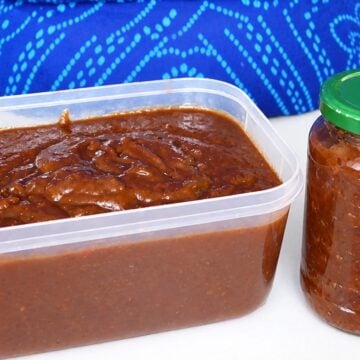
How to Make Tamarind Paste at Home (Homemade Tamarind Paste)
Tamarind paste is a staple everyday basic ingredient that is used almost daily in South Indian cooking. Making Tamarind paste at home is now easy. It is more budget friendly, convenient to make tamarind paste or pulp at home in bulk and freeze. This makes your everyday cooking very easy.
Equipment
Cooking pot
Blender
Ingredients
- 1 kg Seedless Tamarind Fruit
- 2 cups Water
- 1 cup Fine Salt
Instructions
- Take tamarind fruit and break it open into small pieces. Check for seeds, fibre and shells. Remove all of it and discard. You need only tamarind fruit.
- Take the tamarind fruit in a sauce pan. Add water to it and place it on heat. Bring everything to a boil and cook it for 30 mins. Now the tamarind must have softened. Keep mixing inbetween.
- Once tamarind fruit is cooked and softened. Take it off the heat and let it cool uncovered for 30 minutes.
- Take the cooled tamarind pulp in a blender and puree till super smooth. No need to add water. Grind them in batches if needed. It has to be blended till super smooth.
- Once the whole batch is ground. Rinse the blender with some water if needed and add the water to the tamarind pulp. Mix well.
- Now take the tamarind pulp back in the sauce pan. Place it on heat and let it cook for 15 minutes. Keep mixing. This step removes any extra moisture from the tamarind.
- Now Remove this tamarind pulp to the bowl and let it cool down for 30 minutes. Once it is cooled, add salt to the pulp and mix well.
- Transfer this to a large freezer safe container and freeze it. You can scrape as much pulp as you need when it is frozen for your recipes.
- You can store the pulp in a small glass jar in fridge upto a week.
Video
Nutrition
Nutrition Facts
How to Make Tamarind Paste at Home (Homemade Tamarind Paste)
Serving Size
1 kg
Amount per Serving
Calories
2390
% Daily Value*
Fat
6
g
9
%
Saturated Fat
3
g
19
%
Polyunsaturated Fat
1
g
Monounsaturated Fat
2
g
Sodium
113477
mg
4934
%
Potassium
6303
mg
180
%
Carbohydrates
625
g
208
%
Fiber
51
g
213
%
Sugar
388
g
431
%
Protein
28
g
56
%
Vitamin A
300
IU
6
%
Vitamin C
35
mg
42
%
Calcium
824
mg
82
%
Iron
29
mg
161
%
* Percent Daily Values are based on a 2000 calorie diet.