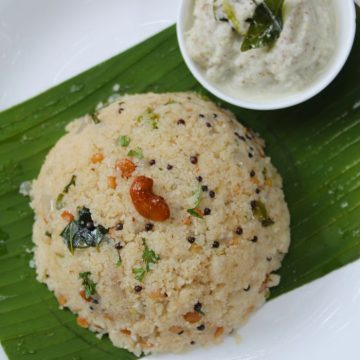
Upma Recipe | Rava Upma Recipe (Easy & Fluffy)
Upma! Basic and popular South Indian Breakfast Recipe which is loved by everyone. Takes less than 15 minutes to make and is a crowd pleaser. Upma also known as Suji ka upma is made with sooji also knowns as cream of wheat or semolina flour. The tempering for upma uses onion, green chillies, ginger and spices like mustard, lentils, cashews. Serve it with coconut chutney or sugar to have a satisfying breakfast.
Ingredients
Upma Recipe
- 1 cup Rava | Suji or Semolina Flour
- 1 medium Onion chopped finely
- 2 Green chilli chopped finely
- 1 teaspoon Ginger grated
- Salt to taste
- 2 cups Water
- 2 tablespoon Coriander leaves for garnishing
- 1 teaspoon Lemon juice to taste
For Tempering
- 2 tablespoon Ghee
- 2 tablespoon Oil
- 2 teaspoon Split Chana dal
- 10 piece Cashews
- 1 teaspoon Split Urad dal
- 1 teaspoon Mustard seeds
- ¼ teaspoon Asafoetida
- 1 sprig Curry leaves
Instructions
- Heat oil in a kadai. Once oil is hot enough, add in chana dal, cashews first and cook on low heat till it gets light golden in colour. Keep mixing for even browning. Now add in mustard seeds and urad dal. Let them sizzle till golden. Add in asafoetida and curry leaves.
- Add in finely chopped onions, green chillies and grated ginger. Saute for 1 minute till the raw smell leaves.
- Add in suji | rava into the onion mixture and start roasting. I add a teaspoon of ghee when roasting the sooji for added aroma. This step is optional. Even though I used roasted suji, I prefer to roast it further for 2 to 3 minutes till golden brown which adds nutty aroma to the cooked Upma. Add salt to the rava and mixw ell.
- Meanwhile I used 2 cups of water for 1 cup of rava. Bring water to a good boil. It has to be hot when you pour into the Upma.
- Once the suji is roasted well, reduce the flame and pour the hot water little at time and mix gently till sooji starts to thicken.
- Add a tablespoon of ghee over the Upma. Sprinkle with chopped coriander leaves. Cover with a lid and cook on low heat for 5 minutes.
- After 5 minutes, open the lid, fluff up the upma and add extra 1 tablespoon ghee, squeeze of lemon juice and mix. Turn off the flame. Cover again and let the Upma sit covered for another 5 minutes. After 5 minutes mix the upma gently and Serve hot.
Video
Nutrition
Nutrition Facts
Upma Recipe | Rava Upma Recipe (Easy & Fluffy)
Serving Size
1 servings
Amount per Serving
Calories
333
% Daily Value*
Fat
17
g
26
%
Saturated Fat
6
g
38
%
Trans Fat
0.03
g
Polyunsaturated Fat
3
g
Monounsaturated Fat
8
g
Cholesterol
19
mg
6
%
Sodium
83
mg
4
%
Potassium
153
mg
4
%
Carbohydrates
38
g
13
%
Fiber
4
g
17
%
Sugar
2
g
2
%
Protein
7
g
14
%
Vitamin A
34
IU
1
%
Vitamin C
15
mg
18
%
Calcium
29
mg
3
%
Iron
2
mg
11
%
* Percent Daily Values are based on a 2000 calorie diet.